Intro
My sister’s best friend tragically lost her father this week to a heart-attack, and my sister reached out to me for some poetry to share with her friend in this time of loss. Her text reminded me that I have been planning to create a list of resources about coping with grief, but I hadn’t gotten around to doing it yet. I texted her back with some of my favorite poems, and made this post a priority on my to-do list.
As someone who has often found comfort in the writing of others, I have amassed a collection of poetry, books, and essays that I turn to when I am struggling with grief, and I want to share them here. I also teach about the AIDS epidemic and violence against LGBTQ people, and have included some readings that I use in the classroom that are about queer grief, and necro-politics (the concept that some lives are seen as disposable by the State).
Everyone grieves differently, so these may not resonate with everyone who finds this list, but they are pieces that I have connected with, and that have helped me know that I am not alone.
The US (and the globe) is in the midst of mass death, and my heart has been aching for everyone who has lost someone to covid-19 and/or is grieving a death in a time of physical distancing. I know I can’t do much to stop what is happening (beyond wearing a mask and practicing physical distancing!) but I hope that these resources can be useful for anyone who needs them. Please offer your own suggestions in the comments.
Edited July 2020: I am adding a few resources that I forgot when I first published this, and have decided to split this into two sections, one that addressed individual/interpersonal experiences of grief, and a second that speaks more to collective grief: black lives matter, queer grief, climate despair, pandemic grief. (Although of course these two sections overlap in many ways).
Individual/Interpersonal Grief
Poetry
The #1 poem that I always share with folks who have lost a loved one is Heavy by Mary Oliver.
“That time
I thought I could not
go any closer to grief
without dying
I went closer,
and I did not die...“It’s not the weight you carry
but how you carry it –
books, bricks, grief –
it’s all in the way
you embrace it, balance it, carry it
when you cannot and would not,
put it down.”
I also love Mary Oliver’s poem, “White Owl Flying in and Out of a Field” for its description of death.
“I thought:
maybe death
isn’t darkness, after all,
but so much light
wrapping itself around us—”
As well as her poem, “When Death Comes.”
When death comes
like the hungry bear in autumn;
when death comes and takes all the bright coins from his purseto buy me, and snaps the purse shut;
when death comes
like the measle-poxwhen death comes
like an iceberg between the shoulder blades,I want to step through the door full of curiosity, wondering:
what is it going to be like, that cottage of darkness?
Essays:
I found the book Tiny Beautiful Things: Advice on Love and Life from Dear Sugar, by Cheryl Strayed to be a helpful text when I was deep in grief-land, and there were three letters in particular that stood out to me, and that I have shared frequently with friends. (The links below go to her original column. I also highly recommend the full book.)
Dear Sugar: The Obliterated Place. (Letter to a Grieving father)
“Your love and grief will be unending, but it will also shift in shape. There are things about your son’s life and your own that you can’t understand now. There are things you will understand in one year, and in ten years, and twenty…The obliterated place is equal parts destruction and creation. The obliterated place is pitch black and bright light. It is water and parched earth. It is mud and it is manna. The real work of deep grief is making a home there…You must come to understand and accept that your son will always be only the man he actually was: the 22 year-old who made it as far as that red light…Your son was your greatest gift in his life and he is your greatest gift in his death too. Receive it. Let your dead boy be your most profound revelation. Create something of him…Make it beautiful.”
Dear Sugar: How You Get Unstuck (Letter to a mother who lost her baby)
“Don’t listen to those people who suggest you should be “over” your daughter’s death by now. The people who squawk the loudest about such things have almost never had to get over any thing. Or at least not any thing that was genuinely, mind-fuckingly, soul-crushingly life altering. Some of those people believe they’re being helpful by minimizing your pain. Others are scared of the intensity of your loss and so they use their words to push your grief away. Many of those people love you and are worthy of your love, but they are not the people who will be helpful to you when it comes to healing the pain of your daughter’s death.
They live on Planet Earth. You live on Planet My Baby Died.
It seems to me that you feel like you’re all alone there. You aren’t. There are women reading this right now who have tears in their eyes. There are women who have spent their days chanting daughter, daughter or son, son silently to themselves. Women who have been privately tormented about the things they did or didn’t do that they fear caused the deaths of their babies. You need to find those women, darling. They’re your tribe.
I know because I’ve lived on a few planets that aren’t Planet Earth myself.”
Dear Sugar: The Black Arc of It (advice to a man whose fiance lost her mother)
The same is true for your fiancé, Bewildered. She is your joy on wheels whose every experience is informed and altered by the fact that she lost the most essential, elemental, primal and central person in her life too soon. I know this without knowing her. It will never be okay that she lost her mother. And the kindest most loving thing you can do for her is to bear witness to that, to muster the strength and courage and humility it takes to accept the enormous reality of its not okayness and be okay with it the same way she has to be. Get comfortable being the man who says oh honey, I’m so sorry for your loss over and over again.
That’s what the people who’ve consoled me the most deeply in my sorrow have done. They’ve spoken those words or something like them every time I needed to hear it; they’ve plainly acknowledged what is invisible to them, but so very real to me. I know saying those cliché and ordinary things makes you feel squirmy and lame. I feel that way too when I say such things to others who have lost someone they loved. We all do. It feels lame because we like to think we can solve things. It feels insufficient because there is nothing we can actually do to change what’s horribly true.
But compassion isn’t about solutions. It’s about giving all the love that you’ve got.
Other books that I highly recommend:
Fishing Secrets of the Dead, by Meredith Davies Hadaway (2005, sadly out of print). Mr. Lane (my surrogate granddad) gave this to me as a graduation present, and it is a cherished possessions. The author is from the Eastern Shore of Maryland, and the prose makes me think of my childhood spent on the rivers and creeks of this rural land. It was a source of great comfort for me after Mr. Lane’s death, as many of the poems explore her grief after her husband’s death, and is a text that I often return to when I am feeling sad. I shared one of her poems, “Visit” on this blog a few years ago.
Survivable World by Ron Mohring (2003), who was my poetry professor at Bucknell. His book of poems about losing his partner to AIDS is incredible, and heartbreaking. It taught me a valuable part of my history as a member of the lgbtq community, and also helped me understand my own grief. One of my students this semester (Spring 2020) was caring for her mother who was dying from cancer, and she said that while the poetry from this book was hard to read, she also found it very healing. (Have linked to amazon, only because I can’t find it at any of the independent bookstores I love.)
What the Living Do by Marie Howe, is another book of poetry that I return to again and again. She writes about her childhood, and relationships, and her brother’s death. You can read the title poem here, “What the Living Do.” which ends with the lines, “I am living. I remember you.”
Artful Grief: a Diary of Healing by Sharon Strouse (2013). This book chronicles the years after Strouse’s child dies by suicide, and the way that she found healing through the art of collage and journaling. I found it particularly helpful in regards to navigating the complicity of grief after suicide, as I have lost a few friends this way. I also appreciate the connections she explores between art and grief. It was helpful to read a text that spans a decade, as it gave me hope that I would find a way to carry the grief, and that over time I would be able to remember loved ones with a smile, and not just tears.
A Widow’s Story by Joyce Carol Oates. Although I am not a widow, this book, which chronicles the year after her husband’s unexpected death, resonated with my own experiences of losing someone suddenly. I used one sentence in particular as a life-line when in the deepest depths of grief, “On the first anniversary of her husband’s death, the widow should think I kept myself alive.”
And finally, two helpful metaphors for understanding grief: 1. waves and 2. a ball hitting a pain button.
“Alright, here goes. I’m old. What that means is that I’ve survived (so far) and a lot of people I’ve known and loved did not. I’ve lost friends, best friends, acquaintances, co-workers, grandparents, mom, relatives, teachers, mentors, students, neighbors, and a host of other folks. I have no children, and I can’t imagine the pain it must be to lose a child. But here’s my two cents.
I wish I could say you get used to people dying. I never did. I don’t want to. It tears a hole through me whenever somebody I love dies, no matter the circumstances. But I don’t want it to “not matter”. I don’t want it to be something that just passes. My scars are a testament to the love and the relationship that I had for and with that person. And if the scar is deep, so was the love.
As for grief, you’ll find it comes in waves…In the beginning, the waves are 100 feet tall and crash over you without mercy. They come 10 seconds apart and don’t even give you time to catch your breath. All you can do is hang on and float. After a while, maybe weeks, maybe months, you’ll find the waves are still 100 feet tall, but they come further apart. When they come, they still crash all over you and wipe you out. But in between, you can breathe, you can function. You never know what’s going to trigger the grief. It might be a song, a picture, a street intersection, the smell of a cup of coffee. It can be just about anything…and the wave comes crashing. But in between waves, there is life.”
From a comment on Reddit.
The Ball and Button Analogy: (Posted on twitter by Lauren Hershel, and explained here on The Mighty).
“Herschel drew a box (square) with a ball (circle) inside. On the left side of box is a red “button.” When the grief is new, she explained, the ball takes up most of the box and is hitting the button, which represents pain, over and over again. The pain is fairly constant.
“In the beginning, the ball is huge,” Herschel said in a tweet. “You can’t move the box without the ball hitting the pain button. It rattles around on its own in there and hits the button over and over. You can’t control it – it just keeps hurting. Sometimes it seems unrelenting.”
Over time, the ball shrinks — but every now and then, it still hits the button. Maybe you see someone who reminds you of your loved one. Maybe a certain song plays on the radio. Maybe it comes out of nowhere.”
Collective Grief
Black Lives Matter/Black Bereavement
The poem below, “Not an Elegy for Mike Brown” by Danez Smith, captures the grief and anger that comes when yet another black person is killed by the police. I am sharing a youtube clip of them performing it, but you can find a written version (slightly different last lines here.) I highly recommend their other poetry as well, especially “Dinosaurs in the Hood”.
“Black Bereavement, White Condolences” by Marina Magloire (Boston Review, 2020). Please read this essay in it’s entirety if you can, as my quote does not do it justice.
“Relationships between black people and well-intentioned white people have transformed overnight into a relationship between the bereaved and those who, sometimes awkwardly, wish to comfort us. Varied even in our grief, we the black bereaved need different things from the white sympathizers in our lives. Some of us want check-ins and accountability, and find our solace in the visibility of social media. Some need a little financial help in this trying time. Some people want to trade stories at the wake, and like to hear the names of the dead passed through unknown mouths. Some of us just want you to bring a casserole and listen to us cry. And maybe some of us just don’t want to accept a casserole from someone who was complicit in our beloved relative’s death, you know? This metaphor of bereavement breaks down when we consider how long black people have been grieving, and how long it took for white people to offer condolences. This sudden attention to the ongoing grief of black life can also feel like a slap in the face. Didn’t you notice we were dying?
…I know what I want and need from other black people as simply and clearly as I want and need air: to be in community. From white people, my desires are more complicated.
…Since white people are supposedly interested in my grief now—not just my book recommendations and my validation of their allyship, but my unlovely, honest-to-god grief—I’m telling you to keep bringing the casseroles. And that they will never be enough. But bring them anyway.”
Queer Grief and Necropolitics
This first essay is one that I teach in my LGBTQ courses, “Pulse and the Power of Queer Tears.” (Slate, 2016). I love what J. Brian Lowder has to say about forms of queer grief, and the way that he connects the Pulse shooting to the AIDS epidemic.
“The answer—the reason why queer modes of mourning seem to strive for the too much—emerges, I think, from the core of queer identity itself. To be queer is to find oneself to be literally excessive: too much for standard understandings of biological necessity, too much for heteronormative ideologies of gender and desire. And this realization can be nothing less than a kind of death…
But then, difference—and the perspective that comes with it—is also a gift. Excess can be grounds for celebration. There it is, the ouroboros at the heart of queer consciousness: The thing that makes us special brings us terrible grief, the only honest remedy for which is to exuberantly embrace the cause. Queerness trains you to react to grief excessively, to mourn loss by asserting presence with that much more fervor. That’s why we dance—and sew and write and compose and lip-synch—so wildly around the void. And it’s why, when loss born of injustice visits us, queers have a reputation for acting up.”
I also teach the essay “Pulse, Beat, Rhythm, Cry” by Che Gossett (Verso, 2016) in my LGBTQ Studies courses. Gossett connects the Pulse shooting to necro-politics, and I think it is a useful (although dense) read for anyone trying to understand systemic violence against LGBTQ folks, and people of color.
Audre Lorde said that anger holds information and power. In the wake of the Orlando shooting, we might extend this and say that grief holds information and power. Like so many, I’ve been feeling and sitting in anguish, mourning the collective loss of those precious queer and trans folks of color killed at Pulse. Several queer and trans people of color I know were asked the Monday after how their weekends were by seemingly oblivious straight people which speaks to the racialized antagonism, to channel Hortense Spillers, inscribed in queer and/or trans of color memory. Queer and trans people of color are not meant to be here and sometimes we survive but often our lives are violently stolen, our lights-as-life extinguished. I’m awash in a flood of sadness and anger, as we are once again confronted with violence, trauma and the accompanying grief, fracturing time itself.
Climate Despair
“Climate Despair is Making People Give Up on Life” by Mike Pearl (Vice, 2019). This essay focuses mostly on the anxiety and despair of climate change, but points out that we need to acknowledge grief to be able to move towards action.
“…there’s another, much older and simpler way to process despair. Give into it for a moment. Cry it out. Let yourself acknowledge how fucking bad it all is, and how a lot of it is never, ever getting better. In short: grieve.
Ruttan Walker told me she often uses grief as a way to process her emotions about climate. “We have to acknowledge that we’ve changed our planet. We’ve made it more dangerous and we’ve done harm,” she said.
…”Grief is a process. A recognition,” Ruttan Walker explained. “But you can still move on.”
“Apocalypse Got You Down? Maybe This Will Help: Searching for a cure for my climate crisis grief.” by Cara Buckley (New York Times, 2019). I highly recommend this entire essay.
“We know that the future is looking bad, that the present already is, and that inaction, especially here in America, is making it all worse. But how are we supposed to live in our hearts and souls with such an existential threat that is also, as birds and bees vanish and trees topple and die, so excruciatingly intimate?
…It looks like this: Live like the crisis is urgent. Embrace the pain, but don’t stop there. Seek out a spiritual path to forge gratitude, compassion and acceptance, because operating out of denial, anger or fear only hurts us in the end.
…The key is to channel it, through everyday actions or joining wider movements, and also to figure out a way to face it without being controlled by it, because operating out of fear, anger and blame burns us out. That is where the spiritual component comes in — to find a way to move to a place not of tacit acceptance, but of fierce, roaring compassion.”
Pandemic Grief
Here I do not just mean the grief of folks who have lost loved ones to covid-19, but also the feeling of collective grief that comes from living through such a life-altering event like a pandemic. This was an article that came out in March 2020, “That Discomfort You are Feeling is Grief” by Scott Berinato, interviewing David Kessler.
“..we’re feeling a number of different griefs. We feel the world has changed, and it has. We know this is temporary, but it doesn’t feel that way, and we realize things will be different. Just as going to the airport is forever different from how it was before 9/11, things will change and this is the point at which they changed. The loss of normalcy; the fear of economic toll; the loss of connection. This is hitting us and we’re grieving. Collectively. We are not used to this kind of collective grief in the air…
…we’re also feeling anticipatory grief. Anticipatory grief is that feeling we get about what the future holds when we’re uncertain. Usually it centers on death. We feel it when someone gets a dire diagnosis or when we have the normal thought that we’ll lose a parent someday. Anticipatory grief is also more broadly imagined futures. There is a storm coming. There’s something bad out there. With a virus, this kind of grief is so confusing for people. Our primitive mind knows something bad is happening, but you can’t see it. This breaks our sense of safety. We’re feeling that loss of safety. I don’t think we’ve collectively lost our sense of general safety like this. Individually or as smaller groups, people have felt this. But all together, this is new. We are grieving on a micro and a macro level.
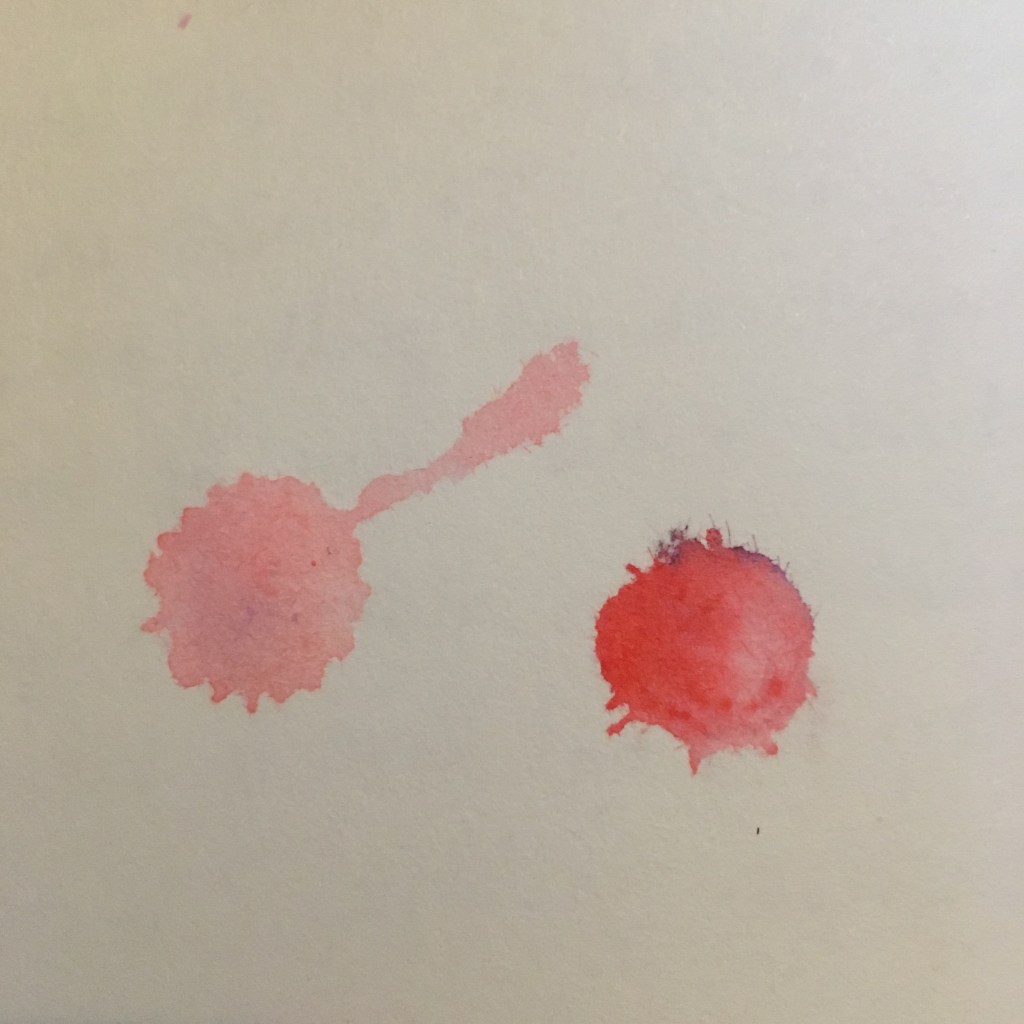
[Cover photo is a photo of two tear splashes in my journal, colored in with pink marker]


 The Spaces In Between
Leave a reply to Leaving DePauw, Onwards to Wells! – The Spaces In Between Cancel reply