As someone who cares deeply about teaching and my students, moving my classes online has been an emotion-filled process. I have been stressed about the time and work required to adapt my courses, worried about making the right decisions about assignments and grades, anxious about my students’ well-being, and sad about the fact that I won’t have a chance to see my students again in person. We left for Spring Break not knowing that classes would not resume, and since I am leaving Dickinson in June (at the end of my visiting one-year contract), I will not even have the chance to see them again in the Fall.
Fortunately, there have been several articles online that have helped me make the transition to remote-teaching, including many written by Rebecca Barrett-Fox, who has been teaching online for years (and who runs the Any Good Thing Writing Challenge that I do every month). She has a fantastic piece addressing the difference between a planned online course, and a move to remote-learning in a time of pandemic. Her basic advice is to keep it simple, recognizing that many students are now working at home, may not have solid internet access, may be in different time-zones, and are dealing with a lot of anxiety and stress during these times. She also makes a solid argument here, and in a later blog post, about why we shouldn’t require synchronous classes.
The article calmed a lot of my initial anxiety about moving to remote-learning. These are not normal times. Ultimately, my students’ well-being is more important to me than creating the perfect online class, and I can still provide them with a rich learning environment, without making it too complicated. That said, keeping it simple is easier said than done. And I have had to make several decisions about how to move classes forward, especially in regards to synchronous vs. asynchronous classwork, grades, and shifting assignments. Below, I share the decisions that I made, guided by articles like Rebecca’s above, posts in the Online Learning Collective Facebook Group, and responses my students gave to my survey about access needs (most have internet/computer access but not all). I have also been guided in my thinking by this set of principals written by Brandon Bayne, which I included on all of the updated syllabi that I sent to students last week.
1. Synchronous classes: When we were first told that we might have to consider remote-learning, I thought I would host synchronous Zoom classes at least once a week, but after reading Rebecca’s article, I worried about inequities in regards to access. Many of my students noted on the survey that they wanted to continue with face to face online classes, and over 95 percent have access to a computer and wifi. Zoom also has an audio option where students can call in via cell-phone. But what about students who do not have access even via the phone? Is it fair to require synchronous classes in a time of pandemic?
Ultimately, I decided to give students the option to attend a Zoom class once a week. This will function to provide a sense of normalcy, connection, and social time among my students and with me, but I am not requiring it. I recognize there are access issues (or time differences, one student is now on the West Coast, and I am not going to make him show up to a 6 am class!) and I will record classes when it is appropriate to do so (this will depend on the class, as some of the topics are fairly sensitive in WGSS/Trans Studies), and will provide notes afterwards for anyone who couldn’t or didn’t want to Zoom in. I know that it will contribute to a different experience among students, and is potentially contributing to inequity, but I decided it was the right choice for my classes. As we move through the semester, I can see how this is working, and re-evaluate if need be.
This week I had my first classes via Zoom, and I was surprised to see how many attended my 9 am class on Thursday (10/14). It was a relief to see their faces, and to be able to teach again! I have missed my students, and teaching; it is something I deeply love and I thrive in a classroom. Many of them remarked that they appreciated having class, and the opportunity to think about something other than Covid-19. My other two classes had lower attendance (2/11) and (5/25) but again it was nice to see their faces and to be able to check-in and talk about class topics. It was especially gratifying to teach these classes because I know that they are making an active choice to be there, and it is based on wanting to learn about these topics, rather than being required to attend for a grade.
In my Friday class (with 5 students) we made some zines together as we talked about the readings on sexual assault and gendered violence. I strongly believe in art as feminist pedagogy and activism, and as way to help us think through complicated and sensitive topics. I always include art activities in my in-person class, and I am glad I was able to continue this practice via Zoom. My students all remarked that it was a really nice class, and that they were looking forward to next week’s art activity and discussion.
Teaching via Zoom was also exhausting, something about the interaction over a screen makes it more tiring, and I didn’t get the same energy buzz that I get when I am teaching in front of an in person class. Seeing them, through a screen, also made the reality of our situation sink in a bit more. And that was hard to face. I am not going to see them again in person, at least not at Dickinson, and not in the context of a class. And we are going to be navigating this weird, new way of life, for a long time. Still, I am grateful for technology that connects us, and for the ways that my classes give me something to focus on that is not the uncertain world around us.
2. Grades. Many students in my classes have reached out to say that they are anxious about grades, and that online learning and working for home is difficult for them. I have wanted to acknowledge in my decisions about grades going forward that we are not living or teaching in normal times. Some of my colleagues at other institutions are giving their students all A’s for the semester, as a way to reduce stress and to acknowledge the difficulty of learning during a pandemic. Yet, this didn’t seem like the right choice for my classes, especially given that some of my students have worked their tails off this semester, while others were just sliding by, and others had not turned in any work at all.
Dickinson is giving professors the choice to switch their class to credit/no credit for the semester (meaning you only need to earn a D grade to get credit), and all students have the option of doing this at the end of the semester once grades are turned in, even if their professor sticks to a graded system. Given that students can make this choice themselves, and given the fact that letter grades can have a significant impact on GPAs, financial aid, and graduate school, I have chosen to keep letter grades for my classes.
However, I also know my students are navigating high amounts of anxiety/stress at this time, and thus I decided to offer my two intro classes the opportunity to “freeze” their grade at the Spring Break mark. In my experience mid-term grades are a pretty good representative of final grades, except for cases where students’ do poorly on initial assignments and then are able to work hard and pull their grade up. Or in cases where students start off well, and then bomb the rest of the semester, usually for personal/mental health reasons. I don’t want this pandemic to be the reason someone’s grade tanks, and I also want students to be able to pull their grade up if they struggled in the beginning of the semester. There hasn’t been much written about this option, and I wondered if this was the “right” choice, but it felt the most fair given my class structure/assignments, and the current situation, and so far I have been getting a lot of feed-back from students about how grateful they are to be given this option.
My third class is an upper-level course. They had only turned in one assignment pre-Spring Break, and their end of the semester project makes up the bulk of their grade. So I decided it did not make sense to give them a “freeze” option, given that they have not completed as much work as my other classes. Still, I will be flexible with all of them in terms of due dates, and will work to make sure that they are still able to be successful in the course.
As I wrote in one of my update emails to my students as I was adapting my courses:
“Please know that I care most about your well-being, mental and physical. Classwork can get figured out over the next few weeks, and I am going to do my best to make this transition to remote-learning as smooth as possible, and will be as flexible as possible. I hope that our class can be a source of distraction, fun learning, social time with people who get it, and a way to keep your brain moving. I do not want it to be a source of stress or anxiety.”
3. Assignments. Another decision I needed to make was around assignments. As is usual in my courses, my two intro classes had a group project as the mid-semester assessment. We were just starting to talk about it before Spring Break, and they were going to form their groups when we got back. Now with the move to remote-learning, I wondered, was this the time, as one colleague suggested, for my students to learn how to work together entirely on-line? Or was a group project too much added stress, especially given the fact that they wouldn’t have the in-class scaffolding that I usually provide? In the end, I decided to cancel the group project, and move those points to the discussion board posts that they will be required to make for the rest of the semester for class participation. They will have other opportunities to learn how to work in groups, and the most effective ways to use different online tools, and hastily modifying the group project at this time would mean losing some of the key elements of the assignment.
Who Am I as A Teacher?
Moving my classes online has made me take a deep, hard look at myself and my teaching philosophy. I want the decisions that I make to reflect my investments in teaching and learning, my knowledge about my students, and what I think is most important about my classes and this moment in time. Along with all of the resources that I cited above, I have been thinking a lot about Robert Palmer’s The Courage to Teach which I read over Thanksgiving, especially his chapter on integrity.
He writes, “good teaching cannot be reduced to technique; good teaching comes from the identity and integrity of the teacher.” (2007, pg 10).
My decisions are ones that must make sense for me and my classes, and reflect my own teaching values, and who I understand myself to be as a teacher. He also writes about moving away from a culture of fear within teaching, which seems appropriate for these times too, and for knowing how we work best in the classroom. Some folks are best at delivering engaging, high-energetic lectures, other folks excel at creating interactive in-class discussions. He gives us permission to recognize our strengths and our weaknesses, and I think this is even more important to understand at a moment like this when we may be engaging with teaching technologies that we are not familiar with. Our online classes are going to look different based on our own capabilities and the needs and abilities of our students. We are all living in unprecedented times, and it is going to take a whole lot of courage to make it through.
Moving Forward:
We are also living in a time of grief (Scott Bernato) and are about to face unimaginable losses without even being able to mourn the way that we usually do (Ramtin Arablouei) We will have to adapt our teaching (Rebecca Barrett Fox) and lives to that reality too, over the next few weeks/months/years. As someone who lost several loved ones in a short amount of time, and who has learned to navigate deep grief over the last decade, I am both scared for what is to come, and also have a sense of calm about it. I know this pain, and I have survived things I did not imagine I could survive. I hope to also write more about this aspect of our current life, in the next few weeks so stay tuned for some more blog posts from me soon. Thanks, as always, for reading!
(edited to add: my blog post with resources on grief is now up, and can be found here.)
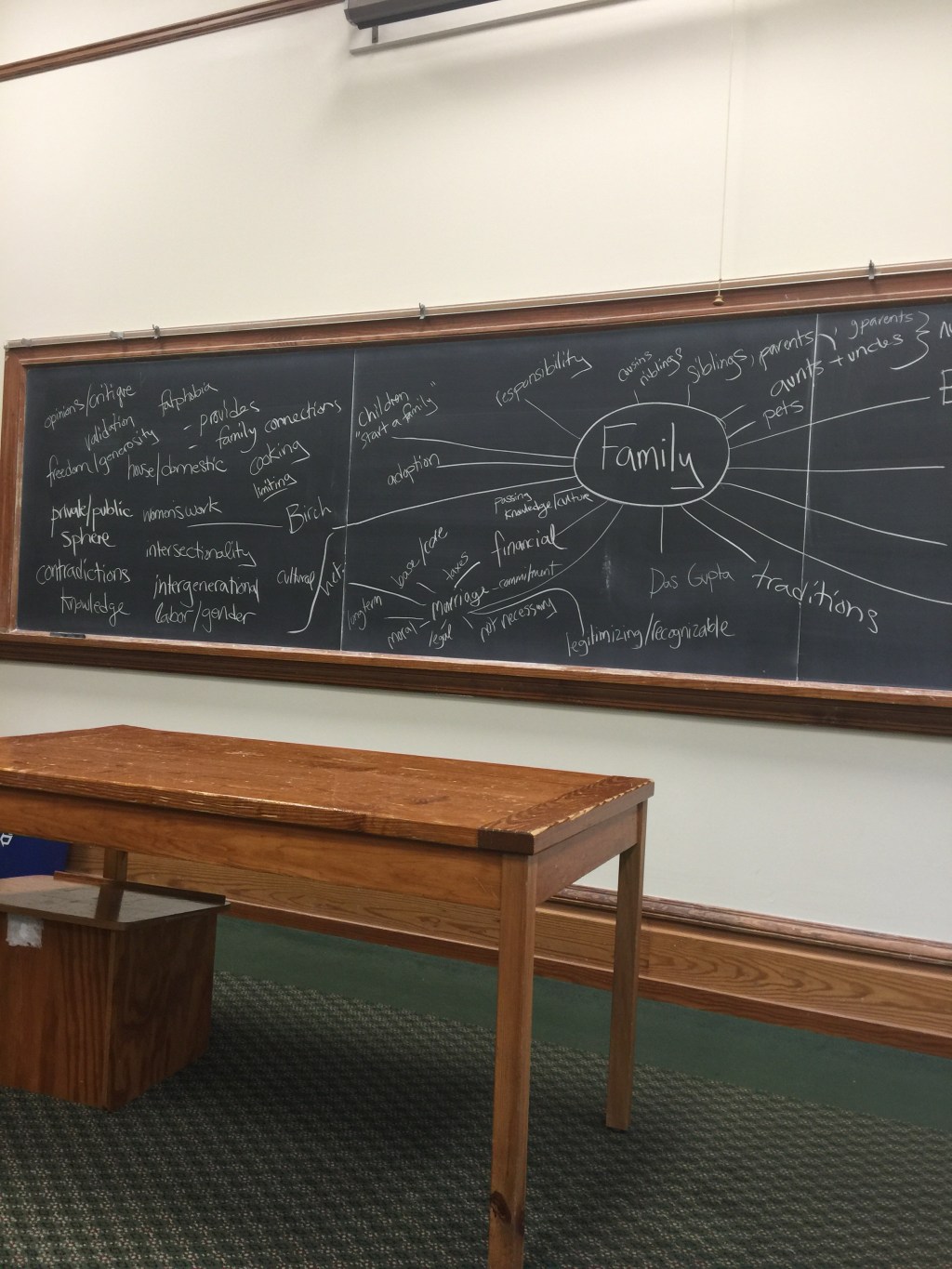
Cover photo is an image of my board during the family unit of Intro to Women’s and Gender Studies. Taken by a student, Patience Bulus.
 The Spaces In Between
Leave a reply to 2020 In Review – The Spaces In Between Cancel reply