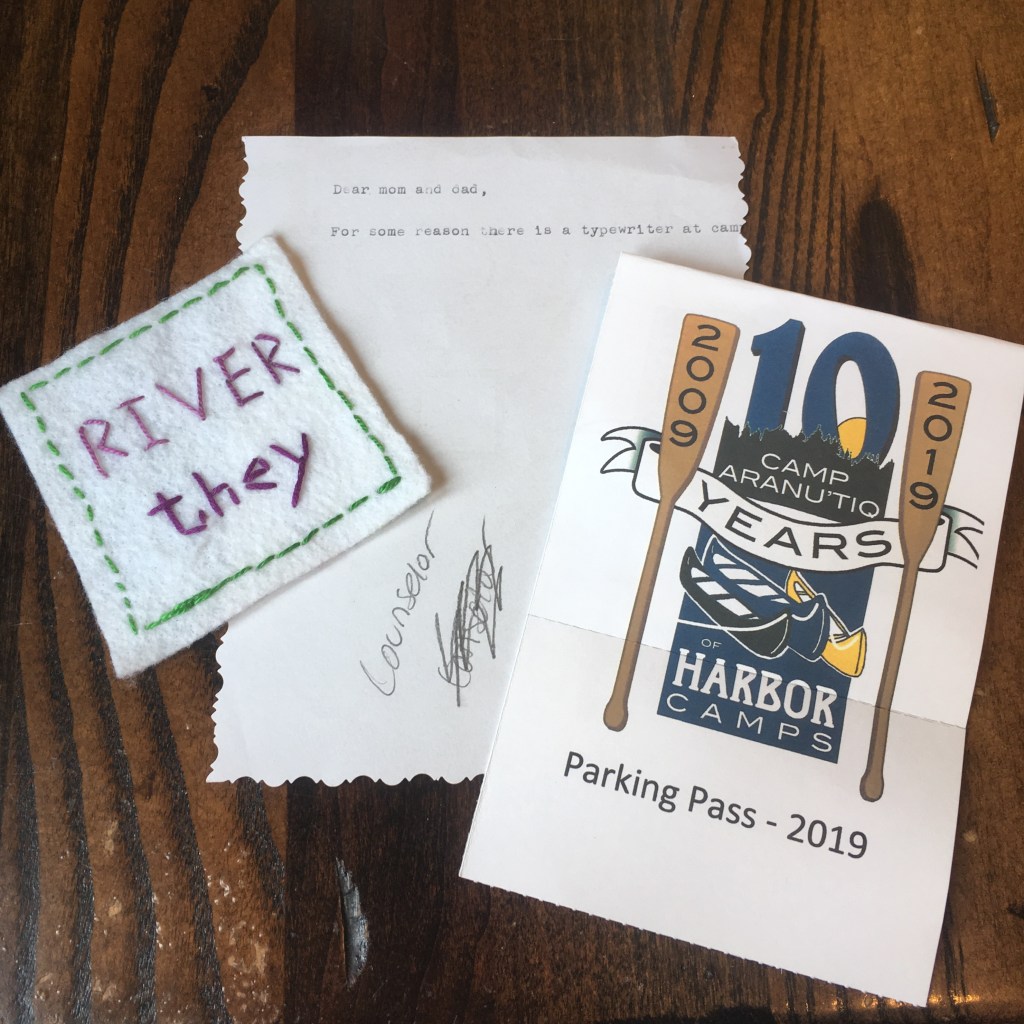
Since 2015 I have spent at least a part of my summer at Harbor Camps, which hosts Camp Aranu’tiq, a camp for trans kids, Camp Seneb, a camp for kids with dwarfism, and (started in 2019) Camp Reflections, a camp for kids with cranio-facial differences. The camps are organized like a traditional summer camp and provide a space for kids to find community with other kids like themselves. I have worked at both Camp Aranu’tiq and Camp Seneb, although the majority of my experience is with the former. I dearly love the 116 acre lake-side property, the New Hampshire Mountains, and the sense of community that I have found at camp. Today I want to share a little bit of the magic with you. (Also see here for some stories from Family Camp 2018).
For Some Reason There is a Type-Writer at Camp
The last two summers I have been Arts and Crafts Activity Head, directing the arts program, creating lesson plans in collaboration with my counselors, and supervising art activities. This year we collaged with National Geographic magazines and maps, painted rocks, sticks, and canvases, created self-portraits and woven tapestries, needle-felted, and made buttons, duct-tape wallets, art journals, clay, and friendship bracelets. A highlight of the summer was Sculpey Clay and a toaster oven to bake it; the kids had a ton of fun making mini figurines and fairy homes. We also collectively worked to untangle a 4-foot-in-diameter ball of very tangled embroidery thread!
This year I also brought my type-writer to camp. I wasn’t sure what the campers would make of it, but they were completely enamored! Over-hearing the kids explain what it was to each other was amusing, “This is a very, very old machine from when they didn’t have computers.” They weren’t wrong–but their tone always suggested some ancient technology from a time of the Roman Empire or Medieval England, while at the same time they asked me, “Did you type all of your college essays on this type-writer!?” (Not sure what that means in regards to how old they think I am!) When it “ran out of ink” I showed them that it didn’t have ink cartridges, but instead had a ribbon that I needed to wind. Sometimes they would say “It’s out of ink,” when they just needed to hit the keys much harder than they were used to doing on a phone or computer keyboards.
The first few days the kids typed a lot of nonsense words or long repetitions of silly camp songs but then they started writing letters to their parents and other campers. They often brought in hand-written drafts to copy, because as one kid said “you can’t erase mistakes on a type-writer.” They would then sit down and painstakingly type out their letter.
I found one discarded draft with two lines:
“Dear Mom and Dad,
For some reason there is a type-writer at camp.”
Another camper wrote some interesting fiction, including a story that began “It is the year 3000 and the food stocks are running low.” I was impressed with the campers’ patience and tenacity with the type-writer, I thought they would get bored with it quickly, but there was always a line of campers waiting to use it. I was also worried they might break it (and brought it knowing that was a possibility with so many kids using it) but with the exception of a bent N key (which still works, you just have to smash it a bit harder) it survived two weeks of almost constant use!
I loved hearing the clickety-clack of the type-writer everytime I was in Arts and Crafts, and in preparation for next year I have been keeping an eye out for used type-writers, and have bought two to donate to camp next summer. This will cut down on the lines of campers waiting for the type-writer, and I can leave my personal type-writer at home.
Box Troll Lives On
One of my favorite things about being in Arts and Crafts is watching kids express themselves creatively, and encouraging them to try new things. Art can be a fantastic way to communicate, build community, and have fun. And I never know what the campers are going to think of next!
In summer 2018 “Box Troll” was born from a cardboard box and duct-tape, and he not only survived the winter, but received a brand-new layer of colorful duct-tape this year. It makes me smile as I write this and remember the young campers giggling and laughing with each other as they took turns walking around the Arts and Crafts dressed up as “Box-Troll.”
I love seeing the traditions that build up over time at camp, and watching the returning campers introduce the new campers to their favorite activities, songs, and camp characters, like Box Troll, the Three-Headed Monster, and many more! Aranu’tiq is a wonderful place for trans kids to make new friends, and just have plain fun.
Understanding Gender Through Veery Song
Camp can also be a place for campers to explore their identities, and I love watching them blossom in an environment that recognizes them for who they are. Camp Aranu’tiq has also been a place where I have been able to thrive as a queer mentor, and being in the mountains making art with kids is my version of heaven.
One of the things that we emphasize at camp is that camp is for the camper. All of the counselors and staff are there to make it the best possible experience for all of the kids, and our focus is on their experience and their needs. However, camp is a fun, wonderful, supportive, and safe place for counselors too, where we get to be surrounded by trans and queer community in a way that is rare in everyday life.
As one might imagine, going to Camp Aranu’tiq, and writing a dissertation on raising transgender, gender-creative, and gay kids, has meant that I have done a lot of thinking about identity and gender. I have always identified as a tomboy, and to me, being queer, has always been about both sexuality and gender. Still, over the past few years I have also discovered new ways, additional ways, to understand and name myself and my gender.
A few years ago I named myself River, and this past year I started using that name with close friends, and also they/them pronouns.
I was a little nervous about Camp Aranu’tiq this summer, how was I going to introduce myself? What would I put on my name-tag that we wear every day? I am still figuring out my identity and what it means to be non-binary, and folks at Camp have always known me as Jessica, or more recently, as Jess. I knew Camp is a supportive place, but it still made me nervous to declare something new about myself. Plus it felt complicated, because I am not just River and they/them, but I am also Jess and she/her. So, that is what I put on my name-tag.
Jess/River
they and she
And folks respected it, of course! (That is what Aranu’tiq is all about!) I was asked a few questions about which I preferred, and I would shrug and smile and say, “I like both.” Counselors and campers who knew me as Jess in previous summers usually called me Jess, and new folks mostly called me River, and others interchanged them equally, and thus I was called both and was happy.
Sometimes it has felt difficult to describe this way of being both/and. But this summer I not only felt accepted for who I am, but I also discovered the perfect metaphor for my gender. There is a bird in the New Hampshire mountains called the Veery, which is a song-thrush, and it sings a spiraling flute song with a breathy, magical, echoing sound. (Listen here). The bird actually sings two notes at once, and while listening to the Veery singing in the woods outside of my cabin I realized that the Veery song is a beautiful analogy for my sense of self. I am both/and. I am two notes sung at once.
More Summer Camp Stories to Come
As always, thank-you for reading! I hope you have enjoyed these little snippets of stories from Camp. Stay tuned for more stories from my experiences at Brave Trails and the Spirit Pride Project.


 The Spaces In Between
Leave a reply to jvoor Cancel reply