For six weeks in February and March I was in Europe, visiting my grandparents and old friends, and working on my book project. I took advantage of many travel hours without access to WiFi to catch up on some book reading and it was a pleasure to delve into an eclectic collection of texts, many of which have been on my reading list for a long time. Given how much I enjoyed many of them, I thought I would share some summaries and thoughts about them here.
In no particular order:
The Hidden Life of Trees by Peter Wohlleben
This is a book that has been on my reading list for a long time. It is a nonfiction love letter to, and introductory text about trees and their communities written by a German forester. There is so much that we are starting to learn about how they communicate and feed each other through their roots, take care of their young, and respond to their environments. I found it truly fascinating! Lovers of nature, who are curious to learn more about plant communities, communication, and relationships, should definitely check this book out!
Why I Am No Longer Talking to White People About Race by Reno Eddo-Lodge
This is a book that has been on my list to read for a while, ever since I first read the original blog post that was the beginning of this project. I had not realized that Eddo-Lodge was British, and therefore was even more interested in the book when I picked it up in the bookstore as it gave me a chance to learn more about the specificity of racism and whiteness in Britain. Obviously Britain has a long horrific history of imperialism and colonialism, and yet modern Britain tends to prize itself on being a “multicultural” society that is more progressive than the US. However, this book makes it clear that Britain is still struggling with racism, even if the specifics play out slightly differently within this context than in the US. I found the chapter outlining key moments within the fight for racial justice in Britain to be the most illuminating. However, most of the book was filled with information/concepts that I already knew well from my feminist graduate school training and my anti-racist organizing. That said, it would be very useful for anyone who is just starting to learn about racial justice and whiteness and white privilege, and it is a quick, easy read.
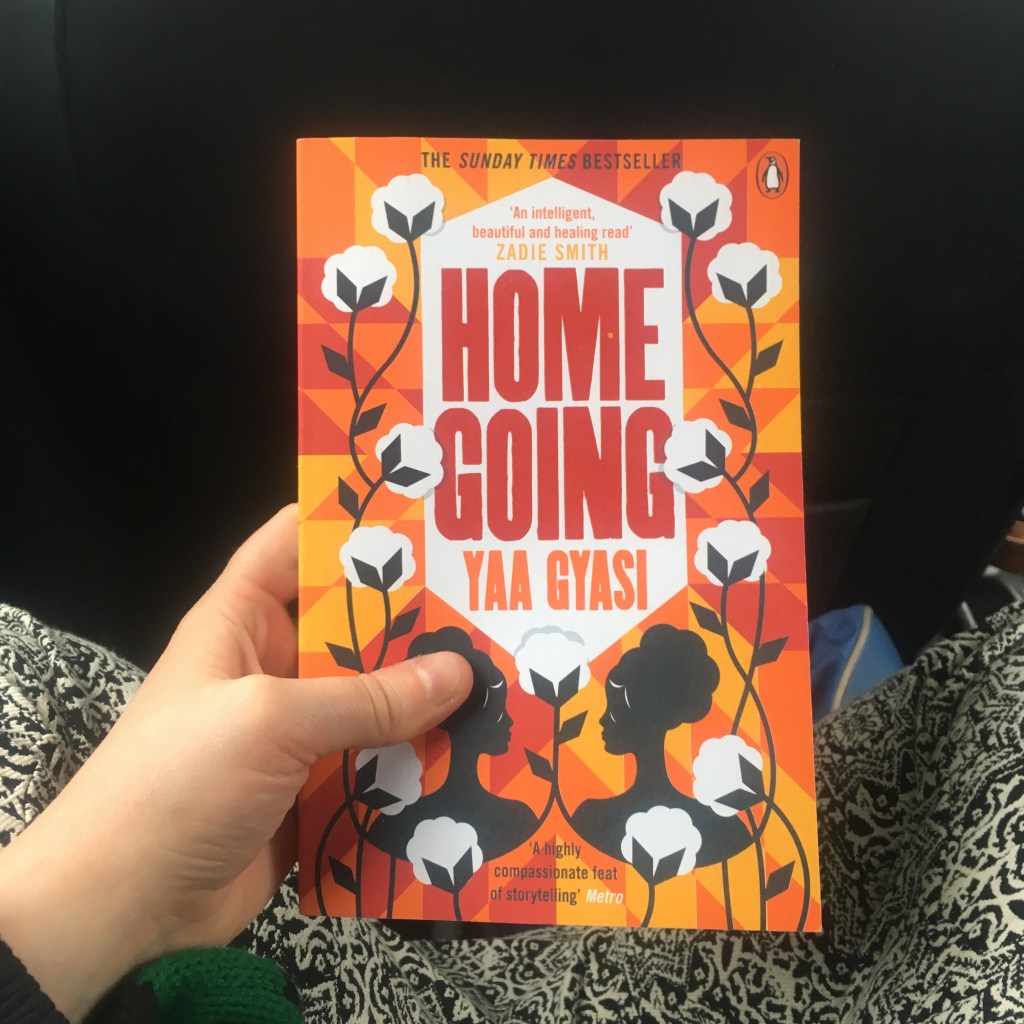
Homegoing by Yaa Gyasi
Run, don’t walk, to your nearest bookstore (or electronic device) and buy this book. It is a spell-binding story that spans the lives of several generations separated by the slave trade, starting in the 1700s, and continuing up through the 20th century. I was blown away with the richness of the characters, the description, emotional intensity, and the clarity of the storytelling. Gyasi vividly brings to life each generation of this family and the brutal effects of slavery, racism, and colonization. My Grandma read it and then bought me (and several friends) a copy and I have been recommending it to everyone I see ever since I finished it myself. If I have the chance to teach a Women’s Studies course in the near future, this book will definitely be on the course list!
Red Dirt Road by Jackie Kay
An adoption memoir, this book is about Jackie Kay’s search for her white Scottish birth mother and black Nigerian birth father. I love the queer autobiographic format, as she weaves back and forth through time and different memories, retelling different moments, adding details, context, and reflections as she cycles back and forth from the moments of meeting her birth parents and the childhood memories that give these context. It is a beautiful ode to her adoptive family and the love that they gave her, while also being frank about the societal racism that she experienced and the ways that they were not able (even with their best efforts) to protect her from it. This was an interesting book to read after Why I No Longer Talk to White People, and it helped me understand even more clearly the racial context of Britain. And Kay is connected to key lesbian and feminist writers like Carol Ann Duffy and Chimianda Adichie which also adds an interesting layer to the text. While the focus is more on race and adoption than Kay’s lesbian identity, this would also make a good book for a queer autobiography book due to the cycling back and forth through time. (It made me think about reading Fun Home in my queer autobiography grad class at UMD, and our discussion of Alison Bechdel’s cyclical storytelling).
I am J by Chris Beam
This is one of the best YA novels I have read with a trans character, and I feel that it lived up to the hype I had heard. While the focus is on the main character’s transition, it is done in a non-pathological way, and avoids the “born x gender” and “becoming y gender” narrative. A friend who I was talking to recently said that they think stories about transition that are not the typical transition stories should be called good coming of age stories and that is definitely an accurate description of this book. Readers are introduced to J from the beginning as himself, even though he has not begun any type of social or medical transition, and the story follows his experiences coming out and navigating family, school, and relationships. I think it captures well the experience of a teenager struggling with their identity, and the book addresses family conflict, as well as homophobia within the trans community and transphobia perpetrated by gay and lesbian people. J is Jewish-Puerto-Rican, and is a multidimensional and complex character, whose voice feels very authentic. While addressing concerns about medical gate-keeping, the book also introduces different resources for trans youth like support groups, therapy and medical clinics. It also has an uplifting message about how family can come to an understanding even when acceptance is still tentative. At times dark, this book does not shy away from the difficulties that can come with being a trans teen, but also offers hope. I would definitely recommend this to all young adult readers, and LGBTQ youth in particular, although it is probably better for teens rather than anyone under 11.
The Argonauts by Maggie Nelson
Someone gave me this when I graduated with my PhD but I hadn’t read it yet. My friend had a copy so I read it while I was in Austria, and I am so glad I finally had a chance to do so! It is an interesting memoir on gender and pregnancy and parenting. Like Red Dirt Road it cycles back and forth between different memories and is beautifully written. I love that it combines a kind of academic style with citations (in the margins rather than as footnotes or in the text), alongside a more narrative autobiographical style.
Worth Every Penny by Sarah Petty and Erin Verbeck
As I get more serious about building my consulting business and summer camp, I have been exploring different “businessy” texts. This book was posted within a doula group that I am a part of, and I quickly skimmed through it. The focus is on “boutique” businesses that charge more because they are selling something unique and providing a particular service. It was the most helpful to me in regard to thinking about branding and messaging, and the idea of becoming an “expert,” although I am still trying to figure out exactly how the text applies to what I might be “selling”!
Bird by Bird: Observations in Writing and Life by Anne Lamott
This is one of the most beautiful books on writing that I have read, and again is a book I highly recommend to everyone, especially writers. Lamott describes the writing process and her writing practices, interweaving humor and life experiences of parenting and friendship and grief. I laughed out loud many times, and nodded frequently in agreement. Her chapter on writing “shitty first drafts” is fantastic as well as her reflections on the writing process and how much staring at your desk happens. She also comments on the importance of going out into the world and going for walks and having life experiences which will then positively influence one’s writing.
Last but not least, From Dissertation to Book by William Germano. This is the book I wish I had read when I was finishing my dissertation or even the first book I had read after I defended. In many ways I feel behind in the process and that I should have started this over a year ago, although there have been many reasons that I did not begin earlier. Germano helpfully points out that sometimes you have to put the dissertation down for a time before revising it (while also urging folks to start thinking about revision (or at least publication of writing) as soon as possible given the academic time clock). Still, there is not use worrying about wasted time, I need to just get to work now! This book is chock full of advice about how to think about the dissertation and what to do with it once you are finished. He breaks down the different options in regard to making articles out of certain chapters, or turning it into a book manuscript, or even just shelving it for a while (or forever). I also found it useful in regard to thinking about why someone would want to publish the dissertation, (if you are going into academia publishing is a must–but depending on the state of the dissertation it may or may not be worth taking the time to publish it) or whether it might be better to focus your energy on a new project and new possible publications.
One thing that I disagreed with was the idea that the dissertation was practice/training for the type of writing/publications that you will do once you defend–in today’s academic market, you can’t wait till you have finished to publish or consider yourself a professional, you have to publish as a grad student! Still, this book felt solid, matter of fact, and made me feel more confident about how to approach my writing. Germano also helped me understand more about the differences between a dissertation and book and gave solid writing/revising tips too. It was nice to read these practical tips about academic writing, and it was a good choice to read after Bird by Bird, which reminded me of the joy and beauty of writing more generally.


 The Spaces In Between
Leave a reply to jvoor Cancel reply