I gave this message at the Poplar Ridge Friends Meeting on December 7th 2025. See full service notes here.
Short prayer or quote: January 25th 1894: “I have been about home all day. Have spent the time reading and studying. I do not know what I should do if it was not for books in the winter season.” So writes Otis Randall, of Monmouth, Maine.
First Hymn: 40 Green Hymnal Dark of Winter
Readings: Winter’s Cloak by Joyce Rupp
This year I do not want
the dark to leave me.
I need its wrap
of silent stillness,
its cloak
of long lasting embrace.
Too much light
has pulled me away
from the chamber
of gestation.
Let the dawns
come late,
let the sunsets
arrive early,
let the evenings
extend themselves
while I lean into
the abyss of my being.
Let me lie in the cave
of my soul,
for too much light
blinds me,
steals the source
of revelation.
Let me seek solace
in the empty places
of winter’s passage,
those vast dark nights
that never fail to shelter me.
Starlings in Winter by Mary Oliver
Chunky and noisy,
but with stars in their black feathers,
they spring from the telephone wire
and instantly
they are acrobats
in the freezing wind.
And now, in the theater of air,
they swing over buildings,
dipping and rising;
they float like one stippled star
that opens,
becomes for a moment fragmented,
then closes again;
and you watch
and you try
but you simply can’t imagine
how they do it
with no articulated instruction, no pause,
only the silent confirmation
that they are this notable thing,
this wheel of many parts, that can rise and spin
over and over again,
full of gorgeous life.
Ah, world, what lessons you prepare for us,
even in the leafless winter,
even in the ashy city.
I am thinking now
of grief, and of getting past it;
I feel my boots
trying to leave the ground,
I feel my heart
pumping hard. I want
to think again of dangerous and noble things.
I want to be light and frolicsome.
I want to be improbable beautiful and afraid of nothing,
as though I had wings.
Message: Winter is my favorite season after Fall; I love snow and colder weather, and the opportunity to slow down and hibernate a bit. Joyce Rupp’s words in her poem “Winter Cloak” resonate with me: “Let me seek solace/in the empty places/of winter’s passage/those vast dark nights/that never fail to shelter me.” I enjoy celebrating the Winter Solstice, and the chance to reflect on the old year and look forward to a new one. And I love curling up on the couch reading with Indigo, covered in blankets, cuddled up with Pippin.
Winter is also hard, especially up here where temperatures can be brutal and snow seems ever-lasting. Last year, I was tired of snow by March, and dismayed about the snow we had in April, even if it was beautiful.
When I was thinking about what to talk about during our Message today, as we go into the darkest month of the year, I kept returning to the words of Otis Randall, from his 1894 diary that I quoted above, “I do not know what I should do if it was not for books in the winter season.” I love how this simple sentence connects him to anyone who has found comfort in books and/or who has struggled in the cold winter months.
For my Message today I want to talk with you about Otis and his diaries and what I have learned from reading them the last few months. I think that they connect to several themes that we often reflect on in Meetings. As with any Teaching, please take what you find useful from my message, and leave anything that doesn’t resonate.
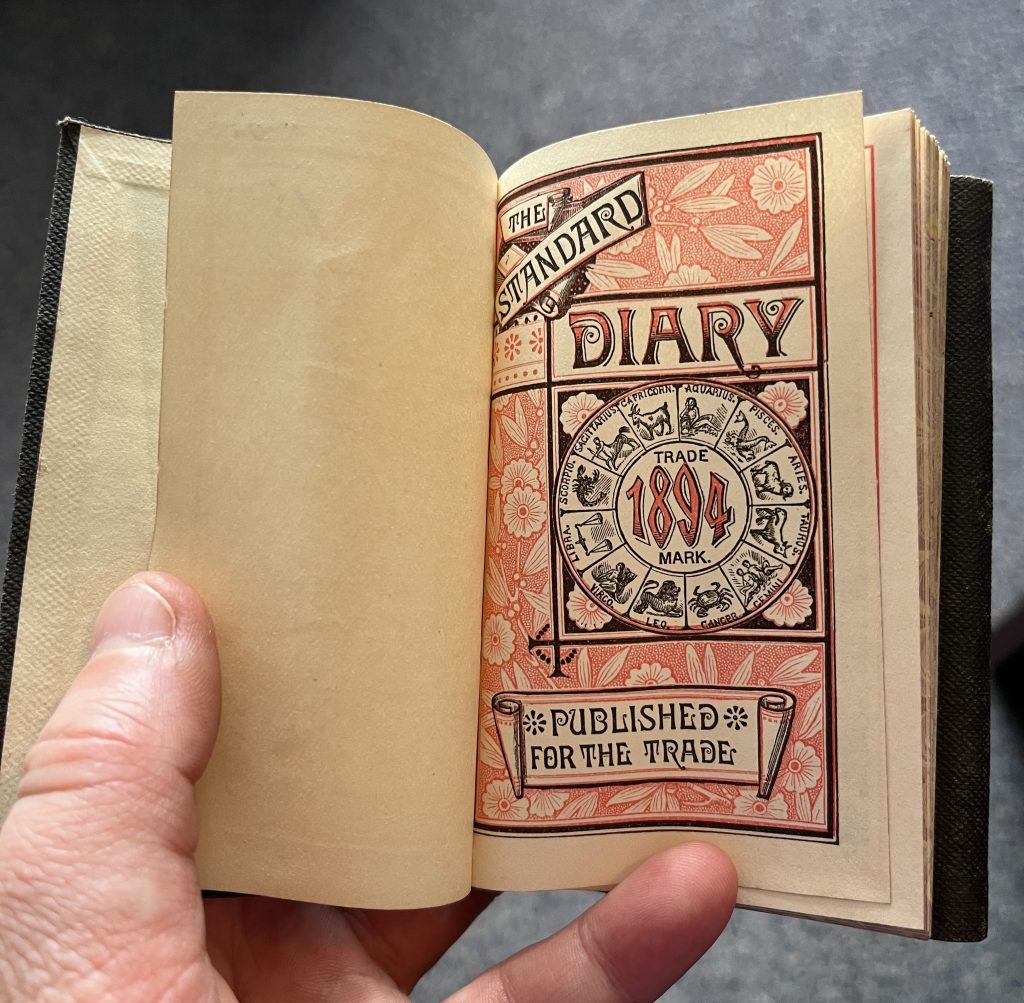
My connection to Otis began 5 years ago, when Indigo and I were still living in Indiana. One day while running errands we passed a community church yard sale, and stopped to take a look at the different wares. There was a pop-up antique stall with a set of very old diaries from the 1870s and 1890s, and early 1900s. Many of them were a similar size/shape and I thought they might be all by the same author. As a diary writer myself, I couldn’t bear the thought of them being separated from each other. After texting some historian friends of mine, and with Indigo’s encouragement, and a bit of price negotiation, we bought them all.
I soon realized that I had at least two writer’s, the 1870s diaries had one set of hand-writing, and the others had different handwriting. I read the 1878 journal soon after I bought the diaries; it was written by a farmer in Tiffin, Ohio, with few identifying details in the text, and then the journals sat on a bookcase until this year when I was searching for a project to keep my brain occupied.
I decided to transcribe the next set of diaries from the 1890s and to try and figure out the identity of the author, who had not included their name in the diaries anywhere.
The 1894 diary has three entries per page, just a couple lines to note the weather and a few things from the day. The author writes primarily about work, and I assume he is a man given the type of work and the time-period. He is a laborer on several different farms. In the winter he shovels snow from the road, and cuts wood, in the spring he sows beans, corn, and peas, and trims the apple trees, in the summer he harvests corn and hay, and in the fall he picks apples and cuts more wood. He also sometimes works at the Creamery, spends time at the Masonic Lodge, and notes whether he attends Church or not every Sunday.
In January 1894 he writes “have not been to the house of the Lord for 6 weeks. Expect my sins ought to be attended to.”
In the back of the diary he lists shoe-shops in Lewiston and Auburn, and purchases from the Monmouth Creamery, which helped me figure out that he was from Monmouth, Maine. Sadly, his mother dies in August of 1894, she had been sick frequently in the months prior. With a date and place, I was able to find her death record: Her name was Almira (Prescott) Randall, she was married to Nathan Randall. Together they had only one son, Otis Randall.
One of the things that I soon found after discovering his name was his obituary.
Even though I knew that he had to be dead given the dates of the diaries, I was still struck by sadness when I read it, as it made his death more real. He died in 1942, at age 74, a week after suffering injuries from falling off a ladder. One thing that was particularly sad to me was that the entry said “there were no survivors.” He never married and didn’t have children.
I have talked to many different people about this project, and several have asked me why I am so invested in these diaries. I enjoy the treasure hunt of deciphering his cursive script, and tracing names through census records. I also feel a deep connection to Otis, despite the fact that we are separated by over a hundred years of time.
In many ways we live very different lives, he writes of shoveling snow so that teams of horses can get through, he mowed hay with a scythe and raked it up into bundles, he picked hundreds of barrels of apples for days that were stored in the cellar all winter long. He lived in Monmouth, Maine his entire life, I have moved several times in just the last few years.
A few weeks ago I visited the Archeology Club at SUNY Cortland to talk with them about my research. One student asked if reading them makes me feel lonely and insignificant, because Otis was forgotten for all these years and there are millions of people like him who have lived and died and are gone from the historical record and people’s memories.
I said that I have the opposite feeling when reading the diaries, I feel connected to Otis and to his humanity and the fact that we are two people separated by time and space, who have shared similar experiences. He records the beautiful moonlight that he sees some evenings, and describes watching the goldenrod bloom, and picking May flowers. He is very attuned to nature and details the changing seasons and weather, and reading his words makes me feel connected to a larger world and the turning of time. As a diarist myself, I wonder what might become of my own journals one hundred years in the future, and what someone reading them would think of the life that I live now.
At the end of his 1894 diary Otis writes, “A year’s record is ended for me, the years pass quickly away. Soon will come the day when we must be gathered into the land where our ancestors have gone on before us. The way is dark but surely it is well trodden.”
In the second diary that I have read, 1896, Otis becomes much more religious. I don’t know if something changed in his life, or if he just had more room to write in this diary so included more of his own thoughts about the world. I initially felt distanced from Otis by this turn towards religion, and his commentary on the vices, and sins of folks in the village, because it is different from my own relationship to spirituality. But instead of turning away, I have continued to read and seek understanding, and moments of connection. I wonder how our world might change if more of us were able to see the humanity in those who are different than us.
In March 1896 Otis writes, “ I have been at the house all day. Did not attend the house of God today I have got a cold in my head, and feel like h—- should not have appreciated the gospel today. I have to feel well in order to be good natured, and have love for God and my fellow men.” That is relatable, I thought when I read it.
In other entries he writes about his concerns that people are turning to materialism and worshipping wealth instead of God; I also worry about the ways that our society valorizes money and wealth over spirituality and human life. Even if we have different belief systems, I am grateful for his reflections on religion, as I dive deeper into my own spirituality and explore what religion means to me.
The diaries also help me feel grateful about the luxuries we have in our homes now, washing machines, and lights, and heat. We have vaccines for our children, and a lot more knowledge about how to prevent illness. One of the things that is clear from the archival records is how many children died before adulthood, and how many people did not make it past their 40s and 50s. This didn’t mean that no-one lived a long life, Otis’ grandmother lived to 100, but so many people in Otis’ family tree did not survive infancy.
I still have no idea how the diaries made it to Indiana or what happened to the others from the missing years. There is much that I still do not know. As is often the case in life, the more answers I find, the more questions I have. I don’t know why he never married, although perhaps a future journal holds more clues. Otis’ mother only had one sibling who survived to adulthood, and he never had children. So her family tree never grew past Otis’s generation.
Otis’s father had 9 siblings, and while many of Otis’ cousins died young, a few of them did have children. I am still tracing those branches of the family tree to see if there are any living descendents.
It will be a good project to keep me occupied through this dark winter.
Unprogrammed worship
Hymn: 220 Love Grows One by One
Closing prayer or message:
I hope in this winter season that you are able to find community and connection, that you embrace the opportunity for rest and contemplation, that you have good books to read, and that you follow your interests and passions, you never know where they might take you.
 The Spaces In Between
Leave a comment